Sunday, August 23, 2015

Flying on Airplanes with Young Children

As an A-lister on Southwest (back when that meant taking more than 50 flights per year), I never was overly bothered by a crying child on an airplane. However, some people have a lower threshold of what they can tolerate. That threshold can be easily breached by the nearby child who is unable to perform all those things that naturally fall within a mature adult's capacity -- to sit quietly for a prolonged period in a particular seat in cramped quarters in an enclosed environment with very few things to do or see. Instead, a child may feel the need to talk loudly, engage neighboring passengers (whether or not the passengers like it), wriggle, refuse to respect the fasten-seat-belt sign, cry, yell, or otherwise be a very young person on a very boring airplane flight.

"Buckled In" by Scott Sherrill-Mix
The recent murmuring about what some people perceive as a need for child-free flights is not entirely new. There have been previous arguments for child-free zones on airplanes. Both arguments raise the issue faced by many parents of how to best travel with their children.  It's not a pleasant experience to get dirty looks from other passengers. Or despite the great love we feel for our own, parents can need a break from their childrens' airplane antics as well.

While I no longer qualify as an A-lister, having family and a house in other states resulted in my logging a fair share of flights with child in hand. From the first few flights of his infancy to the more frequent trips in his preschooler days, we have taken anywhere between 4 to 20 flights per year as a family. In that time, I have learned a few tips and tactics, both from experience and other frequent fliers.

"Toddler's first airplane" by Scott Sherill-Mix

1. Different Travel Distances for Infants, Toddlers, and Preschoolers - Although it seems counter intuitive, travelling longer distances on an airplane can be easier with a small infant than a toddler.  Infants can nurse or bottle feed on take-off and landings, and swallowing can help relieve the air pressure building in their ears which leads to crying.  They can fly free on our laps, and may also sleep easily and often throughout the trip with a minimum of wriggling.  

Toddlers, on the other hand, may want to get up and move around more often, so shorter flights can be preferable. It can be much more of a challenge keeping a toddler happy and entertained in his seat when the "fasten-seat-belt" light comes on.  Due to his increased need for space and physical activity, buying a seat for a toddler can make a long flight more bearable, even if he still technically qualifies for free travel as a lap child.

"Seatback" by Sean Munson
Preschoolers will need their own seat if simply due to age restrictions for free travel (up to age 2). They may be able to handle longer flights in their seats than toddlers, having greater ability to entertain themselves in one place.  Overall, I find cross-country flying easiest with my preschooler. He is now happy in his seat the whole flight and is a good enough walker (and I have strong enough arms) that we don't need to lug around a stroller. I found the same trip most challenging with a toddler who had difficulty sitting in place.  Designing vacation travel around different distances for your children as they age is something to consider.

2. Mystery Bag of Goodies -- A selection of new, age-appropriate toys and books can help keep kids interested and happy in the air.  As a toddler, my son enjoyed walking around the plane and peeking around his seat more than playing with the toys we brought, but he did play a short time with his stuffed animals and sketch pad.  He was also interested in viewing (and ripping up!) the pages of the on-flight magazine and playing with the safety card instructions.  The shiny packages of in-flight snacks became toys to him. As a preschooler, he enjoys coloring at his seat with water-pens, sewing or other travel-friendly crafts, listening to music (especially The Wiggles), and reading books.

"what was in my bag" by Ariel Grimm
3.  Wholesome Meals/Snacks - Adequate food became one of my top travel worries once my little guy was eating solid meals.  Knowing that he was hungry while I was stuck in my seat without  the right foods for him (at the time, I only carried snacks and purees) was an awful feeling.  Also, airplane snacks just don't make the cut for a healthy and filling meal. Some airlines like Virgin America have decent meal-type snacks for purchase, but there is no guarantee that what you want will be available, especially for kids with allergies. 

I now have learned to pack our own food in an insulated lunch bag.  Cut-up hot dogs, cheese, cold meats, fruit and vegetables do a good job as a meal. Child-sized servings of yogurt are also a life-saver for filling a hungry belly when it is lunch-time but we are still a long time away from landing. Goldfish crackers and fortified cereal packed in small, hard, plastic containers are also good to have on hand. Boiled eggs are healthy and portable, along with sandwiches.  Instant oatmeal can also be made by travelling with an oatmeal packet (or use starter baby cereals in a plastic bag) and asking the flight attendant for a cup of hot water.  Food can be prepared either at home or purchased from a supermarket's hot/cold food bar (such as at Whole Foods) when on the go.  Be sure to bring utensils!

"064" by Kelly Polizzi

4. Layover or Direct?  This choice can be highly individual, depending on the child's energy level and cost of direct flights.  On one hand, a layover can provide opportunity for everyone (especially toddlers and preschoolers) with an opportunity to walk and stretch. On the other hand, it can be disruptive for a child who wants to sleep.  If the layover comes at nap time, noisy terminals can make it impossible to sleep, leaving the parent with a cranky, crying child.  

Compared to flying direct, each separate leg of travel increases the risk of delays which can make your child cranky and irritable. A long trip that suddenly becomes even longer can seem unbearable to a little one and result in nonstop crying when finally on the plane. We once had a 7 to 8 hour trip become a 14 hour trip due to delays from our layover. While I sympathized with the people around me who had to hear my child miserably crying, I felt even worse for him.  Anytime we can fly direct, we now try to do so.  It  can be expensive, but budget-friendly airlines like Southwest, Jet Blue, and Virgin America make it a little less painful.

"On our way to America" by Lars Plougmann

5. Time of Day for Flying - One of the greatest travel tips I received was from my executive-platinum-frequent-flying brother-in-law. Fly the first flight of the day for your route. Not only does this avoid delays caused by traffic patterns due to flights ahead of your flight, but it also means clear travelling en route to the airport. In car-heavy cities like Los Angeles, this can mean getting to the airport within 20 minutes without traffic instead of an hour-long drive in traffic.  While taking the first flight of the day can mean rising in the dark before the birds chirp, we have found that the quiet, early morning travel to the airport and plane ride to be vastly more enjoyable for our child than loud, busy mid-day travel when both traffic and chatter is high.  It makes for a calmer child, and is more conducive to helping him nap, compared to travelling at a busier time.

For many more travel tips that go far beyond these, I recommend Travels with Baby by Sherry Rivoli. This book is an incredibly thorough and helpful resource for travelling with kids. I only wish I had discovered it sooner. It is available in both hardcopy and e-reader format.

About the Author
Darlene W. Cancell is an attorney turned stay-at-home mom, and most recently the blog coordinator for Parent Talk.

Do you have special tips for travelling with children? Please share them in the Comments section below.  


Wednesday, August 19, 2015

Flicks on the Field -- Free Screening of The Incredibles


Parent Talk is hosting its annual Flicks on the Field this weekend. Thanks to the YMCA for sponsoring this event!

Source
Bring lawn chairs, blanket, picnic, and of course, the little ones to watch The Incredibles for free at Memorial Field in front of Needham High School on Saturday, August 22, from 6:30 p.m. to 9:00 pm.  Come dressed as your favorite super hero! There will be activities and concessions beginning at 6:30 p.m. and the movie begins at sundown, around 7:45 p.m.  There is also an opportunity to volunteer at this event.  Rain date is Sunday, August 23, 2015. 


Sunday, August 2, 2015

"On My Own" Programs for Kids: When, Why and How to Start

Are you thinking about enrolling your child in “on my own” style activities but are not sure what age is best to start or what program to try first? 

Independent classes for kids can start as early as age 2 and provide a great way to prepare young children for the routine and socialization skills needed in preschool.


Examples of "On My Own" Activities and Recommended Starting Age


2 Years


Preschool Prep – This type of program is valuable because it encourages a child’s natural desire to explore through play and imagination while preparing little ones to become more independent. 

2 1/2 Years 


Art – Every kid loves to get messy and dive into his or her own creation. An art class will give your child exposure to different media, help foster independence, and enhance motor skills.   

Source
Multi-Sports – Children at this age do well with an introduction to fundamental skills across many different sports while having fun.
 
Math – Programs at this age use song and dance to create a fun learning experience focused on numbers and counting.

3 Years


Ballet, Tap, Hip Hop, Jazz, and Tumbling – These classes are popular and introduce technique while improving gross motor skills, coordination, balance and posture. 

Source
Theater – At a very young age, kids can have fun and build self-confidence through dramatic play and creative movement, while learning stage etiquette and performing stories.  

Yoga – Young children are capable of learning and practicing yoga. This type of class incorporates songs, games and stories to hold a child’s interest, build self-confidence, and promote relaxation. 
 
Half-Day Summer Camp – A half-day camp with a low ratio of campers to counselors will provide the right amount of summer fun, activities, and time to make new friends. The low ratio will ensure that your child gets the individual attention he or she needs to succeed within the camp group.  

Source

4 Years  


Beginner Martial Arts – Children can develop confidence, focus and self-control as they learn self-defense skills.  

Benefits of On My Own Programs

  • Have fun while learning new skills
  • Increase creativity and love of learning 
  • Enhance motor skills
  • Socialize
  • Exercise 
  • Build confidence and self-control

Deciding on a Program


With so many choices out there, you may not be sure what to start out with! Speaking from my own experience as a mom, I say, “Go for whatever they get excited about!” Try to really listen and pay attention to what your child enjoys doing, and then look for a program to add to the fun. 

When one of my daughters was very young, I noticed she would always, with no exception, hum or sing a tune while doing something at home that she really enjoyed. She got super productive one day, and proudly came to me with her “bakery” made from paper, crayons, scissors and glue! She actually spent hours on it. From this, I learned that she loved to express herself creatively, so I went with it. Over time, she took independent classes in dance, martial arts, art, piano, and more as her interests changed. 

Source
If your child gets excited about music and loves to move, you may want to start with a dance class. If he or she likes putting on little plays in the family room or sing without anyone listening, you might want to try a theater class. If the child loves to toss a ball around the house and play games of “catch” with you, a multi-sports class can be a great introduction to different sports, teamwork and self-confidence.  

What to Look for in a Program and Facility


Once you know what kind of program you want for your child, the next step is finding a facility that meets your standards. A good enrichment program will grow with your child. And the familiarity of using the same facility for multiple classes will help increase your child’s confidence to try new activities, as he or she gets older. You will want to seek out classes that offer different levels to best fit your child’s abilities. 

A search online in your area will provide some options, and the best way to get a feel for the program is to visit the facility and talk to the instructors. If the program doesn’t look fun, or if you and/or your child are uneasy after visiting, then you need to look for a better fit. Lastly, keep in mind that the staff of a good enrichment facility will make time for both you and your little one and answer all of your questions. You should be able to schedule a time to talk about the program or programs that are best suited for your child.  

From my own personal experience, I can see that what class children take isn't as important as whether or not they enjoy it. Having fun is the best way to learn something new, and each experience has so many benefits. We don’t need to focus on finding programs with the goal of producing artists like Van Gogh or world-renowned dancers like Baryshnikov. Activities at this stage in the game are all about raising confident, independent kids who are not afraid to try new things and be the best they can be. 

After all, my little singing artist is well on her way to a biochemistry degree, and I am certain that her childhood experiences have provided her with skills to succeed. They have helped to shape the fun loving, intelligent woman she is becoming. 

Good luck to you and your little one as you start this fun-filled journey.

About the Author
Grace Tummino is Marketing Specialist at LINX in Wellesley, a company offering classes and camp experiences to help children have fun while they learn.

If you have comments or an experience to share related to this blog, please speak up!

Friday, July 24, 2015

Limiting Pesticides in Summer Fruits and Vegetables

Now is the time to enjoy the fresh offerings of summer --  shining dark cherries, juicy peaches, buttered corn, sugary sweet melons, crisp bell peppers and lots and lots of berries, to name a few.  As parents, we want to make sure that our kids eat as healthily and nutritiously as possible.

source
For many years now, from my past life as a vegetarian to my current days as an omnivore, the vast majority of produce that I have brought into my home has been organic.  Although this preference has resulted in significantly higher costs than buying conventional produce, I believed that doing so would make me healthier, by limiting my pesticide and chemical intake.

Recently, I was surprised to learn that the USDA organic label does not, in fact, completely disallow the use of pesticides.  Instead, what typically sets organic produce apart from conventional produce is not whether pesticides are used, but how the pesticides are made. The USDA organic label allows the use of naturally derived pesticides. Conventionally grown produce is treated with synthetic pesticides.

source
Along with the small shock of this discovery, however, I was glad to find that my years of higher grocery bills were not completely for naught. Organic food has been found to be associated with:
  • Lower levels of pesticides than conventional produce.
  • Higher levels of antioxidants than conventionally grown produce.
  • Production methods that are thought to be more ecologically friendly than conventional food production.
I tend to think, though, that what may be most important in the end is that our families eat a balanced diet. This can be provided either by conventional or organic foods. 

source
The pesticides used in conventional produce generally should not exceed government safety thresholds. That said, I also think there is nothing wrong with parents wanting to give their families a diet at the lowest end of the spectrum for what the government considers acceptable pesticide ingestion.

So, what can be done by parents seeking to further limit their families’ exposure to pesticides? 
  • Consider growing your own fruits and vegetables.  
  • Wash fruits and vegetables under running water and discard outer leaves and skins. Learn more here.
  • Be familiar with the "Dirty Dozen."
  • Eat food from different sources to limit exposure to any one pesticide.
  • Buy locally at Farmers' Markets.
At local farm stands, consumers can personally ask growers what production methods they use.  Asking, “How frequently is your produce sprayed with pesticides?”  and “What type of pesticide do you use?” can inform a purchase.  Local growers may also be more responsive in taking their consumers’ concerns directly into account when considering which production methods to use.

Aside from the issue of pesticides, families may simply be interested in helping to support local growers. Below are links to local farm stands and farmers’ markets.

Dedham Farmers Market (open Wednesdays)

Needham Farmers Market (open Sundays)

Newton Farmers Market (two locations – one open Tuesdays, one open Saturdays)

Powisset Farm Stand (open Tuesdays, Thursdays, Saturdays)

Volante Farms (open daily)

Wellesley Farmers Market (open Saturdays)

Westwood Farmers Market (open Tuesdays)

Lastly, for those who want to help bring the fresh fruits of summer to everyone’s table, there are volunteer opportunities.

One organization, Boston Area Gleaners, collects after-harvest leftovers from local farms to distribute to over 500 hunger-relief organizations in eastern Massachusetts. Gleaning is the ancient practice, dating at least as far back as Biblical times, of collecting the surplus left in farmers’ fields. This group invites volunteers aged 13 and up to help glean the fields of numerous eastern Massachusetts farms.

About the Author
Darlene W. Cancell is an attorney turned stay-at-home mom, and most recently blog coordinator for Parent Talk.

If you have comments or an experience to share related to this blog, please speak up!

Wednesday, June 24, 2015

Making Memories this Fourth of July

My childhood memories of July 4th paint the picture of a quintessential, small town-americana celebration. There was a three day fair with dizzying rides and mouth-watering fried dough, with 4 H blue ribbon competitions, mud runs and a demolition derby. All of this built up to the morning of the Fourth, when dozens of floats representing local businesses and decorated in tissue paper flowers, paraded down Main Street with the high school marching band, little girl baton twirlers, and local pageant winners en route. That evening, we would cook red hot dogs over an open fire at my grand parents' house and watch the fireworks cuddled up in blankets on their roof.
source
I can still remember the anticipation of the Fourth and loved the time we spent together as a family having fun, but I didn't realize then how much I would cherish the memory in retrospect. Now I want to try to create a similar tradition for my children around our wonderful country's big day. Thankfully, we live in a town that also takes pride in its Fourth of July festivities. Speaking of making memories, your child can even have the opportunity to ride their bike in Needham's Children's Parade!
source
In the past, Parent Talk has coordinated an effort to meet and decorate bikes to be used in the Children's Parade route, and we are bringing it back this year. What could be better in the eyes of a child than sprucing up their prized possession with red, white and blue flair and then getting to show it off while riding in the street?! All you need to do is bring the bike; Parent Talk is supplying the decorations. People are gathering at 8am on Saturday, July 4th at Greene's Field in Needham. This fun kick-off event is free and open to non-Parent Talk members as well, so be sure to spread the word!

source
I will be back in my hometown of Houlton, Maine with my husband and our two and three year old. We plan to bring them to the same fair that I grew up loving. I'm not sure about the hot dogs over an open fire! Have a wonderful celebration however you choose to honor the day.

About the author:
Liza d'Hemecourt lives in Needham with her husband and their two children. She grew up in Northern Maine, attended Boston College and taught kindergarten and first grade before becoming a stay at home mother. 


Friday, June 19, 2015

Summer Recipes from Local Moms

We all have our strengths as parents and cooking is not one of mine. I want my children to have a varied and healthy diet but I find the process of meal planning to be daunting and more often than not, I make the same few meals over and over again, which is resulting in picky eaters! Moms who incorporate a rainbow of fresh ingredients and exotic sounding grains into their toddlers dinners never cease to amaze me, so I called upon a few of them to share some favorite summer recipes.
A typical meal at my house! source
These local ladies admit wholeheartedly that even though they present their little ones with impressive meals, it does not mean that they are gobbled up readily. We are still feeding the same species of notoriously discerning and stubborn small people. The difference is, these talented moms see cooking as a creative outlet and are not swayed by rejection; they consider even a mouthful of salmon and cous cous to be a triumph worth the effort! Even if you are already thriving in the kitchen while maintaining harmony among your children, these dishes will be fun to try. And if you are like me, serving frozen meatballs too often, these options will be inspiring, but may take courage to create!

Sally: Grilled Thai Curry Chicken Skewers with Coconut Peanut Sauce

A mutual friend made this dinner for Sally, then she made it for her own family the next week. It was a hit! She likes to serve it with roasted broccoli and coconut rice.

source
For the Chicken you will need:

2--1/2 to 3lb. boneless, skinless chicken breast pounded to 1/2 inch thickness and cut into chunks. Place them into the following marinade for at least four hours or overnight:

1/4 cup soy sauce
  • 3 tablespoons dark brown sugar, packed
  • Zest of one lime
  • 2 tablespoons vegetable oil
  • 3 garlic cloves, minced
  • 1 tablespoon curry powder
  • 1/2 teaspoon ground ginger
  • 1/4 teaspoon ground cardamom
  • 1/2 teaspoon salt

Place chicken on skewers and grill on medium high heat for about ten minutes, turning once.

For the coconut peanut sauce:
Whisk together the following ingredients, except lime juice, bring to a simmer and then cook over medium heat for about three minutes, stirring occasionally. Then add the fresh lime juice. Top chicken with the sauce and use it as a cold salad dressing for any left overs!

1 (13-oz) can coconut milk (do not use low fat)
  • 1/4 cup peanut butter
  • 1/3 cup dark brown sugar, packed
  • 1-1/2 tablespoons soy sauce
  • 1 tablespoon red curry paste
  • 3 tablespoons fresh lime juice, from 2 limes

A mother of two girls, ages 9 and 3, Sally is an Associate Professor of Psychology at Wellesley College. She loves to cook and to bake with the girls. During a playdate, I remember asking her for the method to preparing amazing weeknight meals for her family while working. She said that she usually does breakfast for dinner on their busiest night and takeout on Fridays, but otherwise, finds her recipes for the week in advance, makes her shopping list and shops on the weekend with her 3 year old, who loves grocery shopping!
and usually goes to three different grocery stores with the girls to accomplish that list!

Shalini: Roasted Veggies Reinvented

She begins with an assortment of roasted vegetables and then uses them to make dinner over two nights: first as individual pot pies; second as a side dish with homemade pizza!

For the Roasted Vegetables:
Combine yellow carrots, pepitas, butternut squash, and sweet potatoes with sea salt, pepper and olive oil. Roast at 400 degrees for 20 minutes covered with aluminum foil, and 10 minutes off. 


Meal #1 Individual Pot Pies
Shalini used Martha Stewart's recipe for pie crust, called Pate Brisee. 


Fill two oven-safe soup bowls with the roasted veggie filling below, and top with the Pate Brisee crust. Bake at 375 for twenty minutes. For her pre-schooler, Shalini cut the crust into dinosaur shapes and served them alongside the pie filling. 

For the Pie Filling:

  • Make the roux in a stock pot by warming 3 tablespoons of flour with 1 stick of salted butter, add any chopped mushroom and salt liberally
  • Add about 1/3 of the roasted vegetables 
  • Pour in 2 cups of vegetable stock, tossed in a sprig of rosemary, and let that boil down for about 15 minutes. Take the rosemary out! 
Meal #2 Roasted Veggie Side Dish with Homemade Pizza:

Shalini begins with homemade pizza crust, but you could also use a prepared crust or roll out fresh dough from the grocery store.  


For the pizza topping:
  • Chop sweet, vidalia onions and combine with a balsamic reduction
  • Add mozzarella and basil 
For the Roasted Veggie Side Dish:
  • Add chopped cherry tomatoes and avocado to freshen up the roasted vegetables
Shalini is a lawyer, taking a break from her corporate bankruptcy practice to raise her four year old son and seven month old daughter. I noticed the beautiful meals she was making for her family from pictures posted on Facebook! Shalini says that her mother never really cooked and that she prefers to approach meal planning by working with whatever ingredients she has in the kitchen.

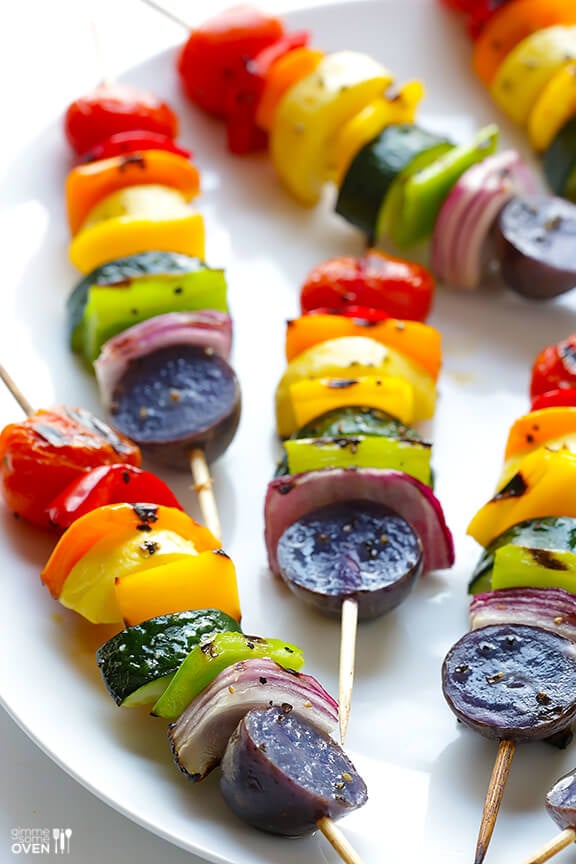
Maggie: Grilled Rainbow Veggie Skewers served with black bean salad and dip!


For the Rainbow Skewers:

Choose any assortment of vegetables that will give you ROY-G-BIV, cut them into chunks, stir them in a bowl with olive oil, season with salt and pepper and grill on skewers until tender!

For the White Bean Dip: 

In a food processor, coarsely chop the ingredients below, then season to taste with salt and pepper. Use this as a dip for the veggie skewers and you have an interactive dinner!

  • 1 15 oz. can of drained and rinsed cannellini beans
  • 2 garlic cloves
  • 2 tablespoons of lemon juice
  • 1/3 cup olive oil
  • 1/4 cup fresh parsley
  • salt
  • pepper

For the Black bean salad:

In large bowl, whisk avocado, cilantro and lime juice together until blended. Add beans, lettuce, tomatoes, corn, pepper, pumpkin seeds and toss until evenly coated.
  • 1 ripe avocado, mashed
  • 1/4 c chopped cilantro
  • 2 T lime juice
  • 2 15oz cans no salt added black beans, rinsed and drained
  • 4 cups shredded romain lettuce or spinach
  • 1 c grape tomatoes, halved
  • 1 c corn kernels, fresh or thawed if frozen
  • 1 small red bell peppers, seeded and chopped
  • 1/2 c toasted pumpkin seeds
Maggie is a dietician and has a three year old daughter and a one year old son. I first noticed her creativity with food when she started her own Facebook page called, Tomorrow's Lunch, featuring fun and nutritious options for her daughter to eat at preschool. Maggie had this to say about preparing healthy dinners for her family: "I think my kids are pretty good eaters, but even they won't eat a lot of most things. They'll try bits and pieces of what I make and I have to round out their meals with fresh, but plain, fruits and veggies, steamed broccoli, roasted cauliflower, pasta with pesto. My thought is as long as they keep trying bites of real, healthy adult food, eventually they'll want to eat more. But I realize, this is a frustrating process for parents."

Monday, June 8, 2015

Two Local Outdoor Gems for the Kids

We are approaching the long, lazy days of summer when schedules are less structured and we can trade time in front of the tv for precious moments running through sprinklers and chasing bugs. If you are looking for an outdoor adventure away from your backyard and local playgrounds, there are many options to choose among in our area. From shady trails through the woods to the neatly patterned rows of crops on a farm, there are exciting and interesting sites to behold that will nurture curiosity and force everyone to slow down and look closely at the wonders of summer while they last. Here is a snapshot of two beautiful spaces to visit with your little ones.

Broadmoor Wildlife Sanctuary

source
This wildlife sanctuary, which is part of the Mass Audubon Society, has over nine miles of trails. Broadmoor is located nearby at 280 Eliot Street in Natick and is the perfect place to burn off some energy outside where you can bring in some educational focus. By observing plants and wildlife that live in the different parts of the sanctuary, you'll be introducing your child to the concept of habitats. Some highlights of the area include beaver dams, nesting wood ducks and basking turtles! Walking through the forest can bring some much needed relief from the heat and you can talk about the different living things you see and compare them to the other parts of the trail such as the wetlands along the boardwalk. This is also a great way to practice skills like looking and listening while being very quiet and tip-toeing to have the best chance at spotting things like chipmunks and waterfowl. Nature walks also feed the imagination! I used to love pretending that fairies and gnomes were hiding among the moss and mushrooms on the forest floor only to come out and dance when no one was looking!

source
Finally, be sure to tie in a quick lesson on respecting our natural environment. In order to maintain the beauty of the trails at Broadmoor and to ensure the safety of all the living things that call it home, they ask that people refrain from running, that they eat only in designated picnic areas and carry out all trash. Visitors are encouraged to bring plenty of water and to wear practical clothing and footwear.

Natick Community Organic Farm

This farm is definitely unlike any I had visited in the Massachusetts area. To say that it is off the beaten path would be an understatement; in fact, the only thing you will find to follow when you get there is a beaten dirt path that leads to the spaces where their various animals are housed. There is no prominent information desk to greet you because your visit is free. Don't expect any posted information aside from signs warning you not put your fingers in the rabbit cages. The reason for this is not that they are inhospitable but that this is a working farm, which gives it a level of authenticity and uniqueness that is refreshing because it is stripped of any commercial efforts (though there is an area where you can purchase organic produce from their many gardens!)

source
I took my two and three year old here for a visit and felt as though time slowed down. Since there are no paved roads and because the area is so far set back from the actual road, I let my children wander. It was such an unusual feeling to be able to let my guard down somewhere outside of my own backyard. I couldn't help think about how the uneven ground and musty animal smells were so good for their senses. We looked in the barn and found a stall swarmed with fluffy chicks, then followed the path to the rabbit kennels and up toward the chicken coop and then to the pastures where goats and kids were grazing. Our favorite part was watching two enormous pigs fighting over the food scraps in one trough. We peeked through greenhouse windows to see the bright green seedlings all lined up, waiting to be planted in the freshly prepared rows of the nearby fields. Just observing the habits of these animals in this very rustic environment made the twenty minute drive well worth it.

Our guide, Heather, was extremely knowledgable and patient!
Of course, my kids wanted to do more than look at all these farm animals, so I inquired about group tours and organized a field trip for our playgroup. For $7 a child, with a minimum of six children, they will assign a teacher to your group and give you a guided tour of the farm. Our focus was on learning about and petting baby animals and aside from the challenge to follow their no running and no screaming rules---it was a huge success!
This mama cow was due to have her baby any day!


About the Author
Liza d'Hemecourt is the blog coordinator for Parent Talk. She formerly taught kindergarten and first grade and now stays home full time with her two children. Liza and her family live in Needham.


Printer Friendly